The SECI model is no longer a story about Combination
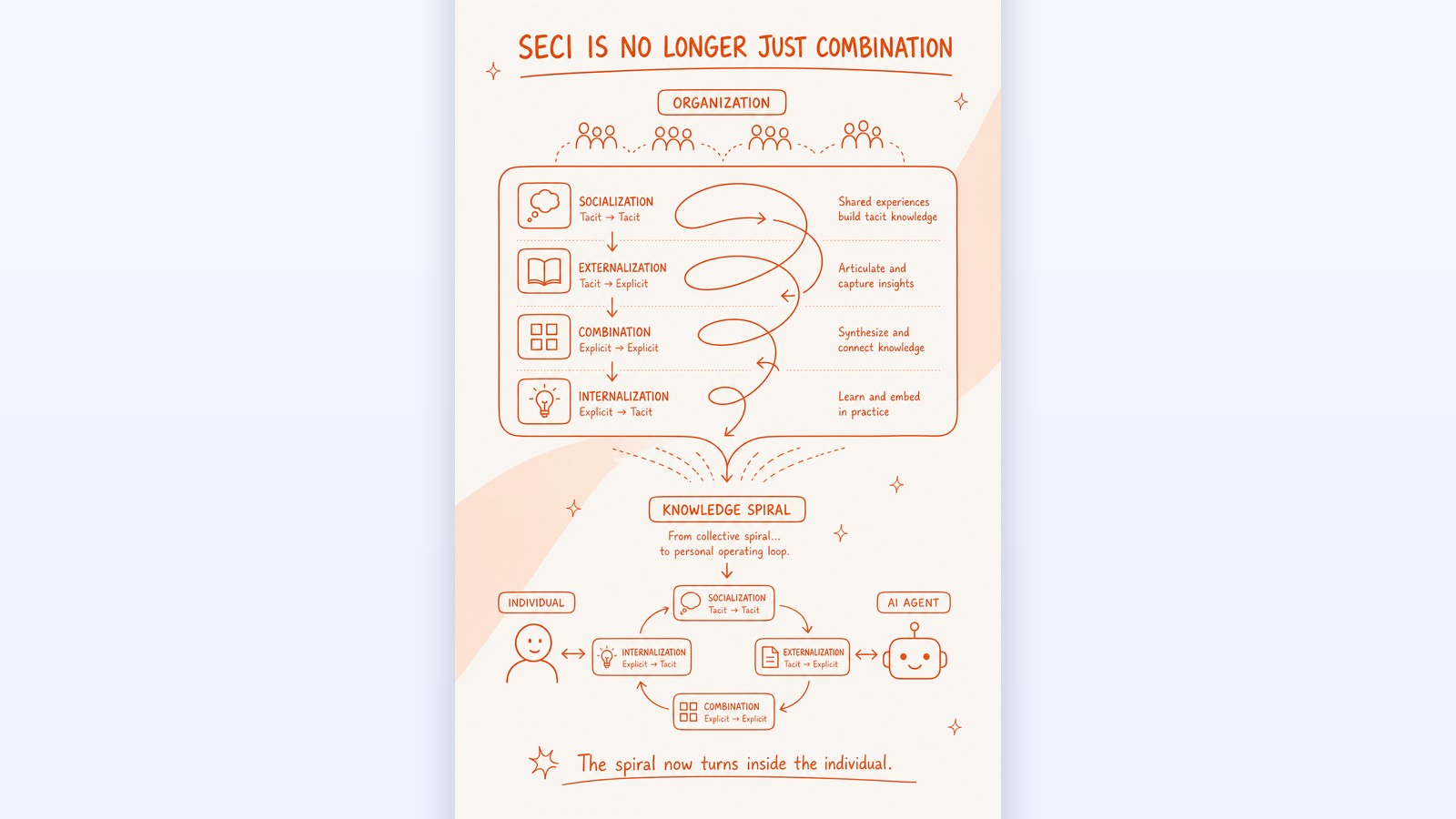
The claim that AI can only handle Combination rests on one assumption: that a record is something a human makes by hand. Passive memory removes that assumption — and the knowledge spiral closes inside a single person.
Knowledge creation for the AI-native individual
The SECI model is a theory from 1995. Ikujiro Nonaka and Hirotaka Takeuchi built it to explain why Japanese companies were able to create knowledge. Thirty years on, nothing in knowledge management gets cited more.
As a theory it still holds. What broke is the assumption people carry when they talk about it.
Four processes, one spiral
Briefly, for the record.
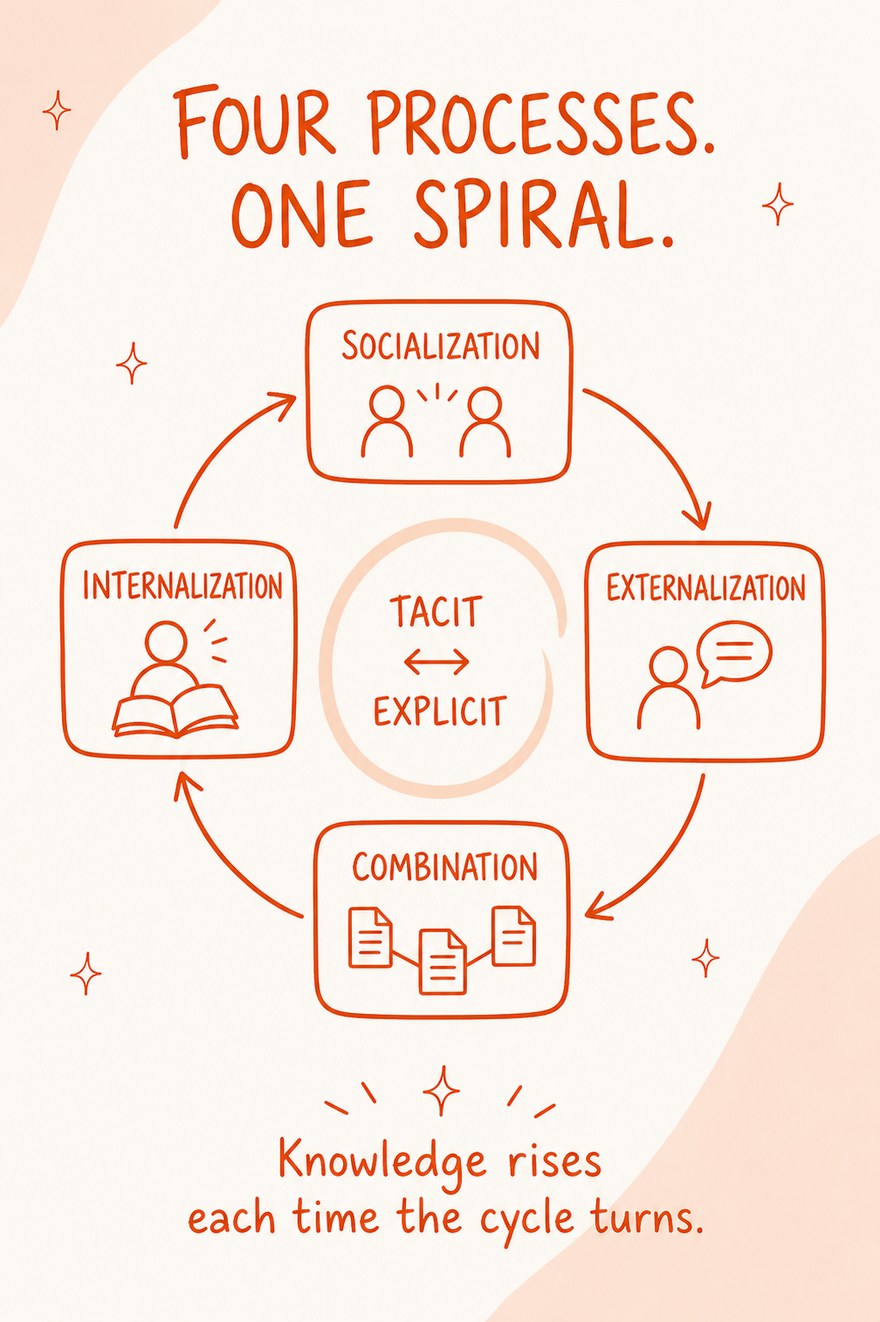
SECI splits knowledge into tacit and explicit, and describes knowledge creation as the conversion between them. Tacit knowledge is what you use without being able to state it — experience, instinct, judgment your body has learned. Explicit knowledge is what has been put into a form you can hand to someone else: a procedure, a dataset.
The two circulate through four processes.
- Socialization — tacit knowledge passes to another person as tacit knowledge, by sharing the experience
- Externalization — tacit knowledge is put into words or diagrams
- Combination — pieces of explicit knowledge are assembled into a system
- Internalization — explicit knowledge is practiced until it becomes your own judgment
The point is that it doesn't stop after one lap. An individual's insight spreads to a team, becomes organizational knowledge, and returns to the individual. Nonaka called it a spiral. Each turn raises the altitude of the knowledge.
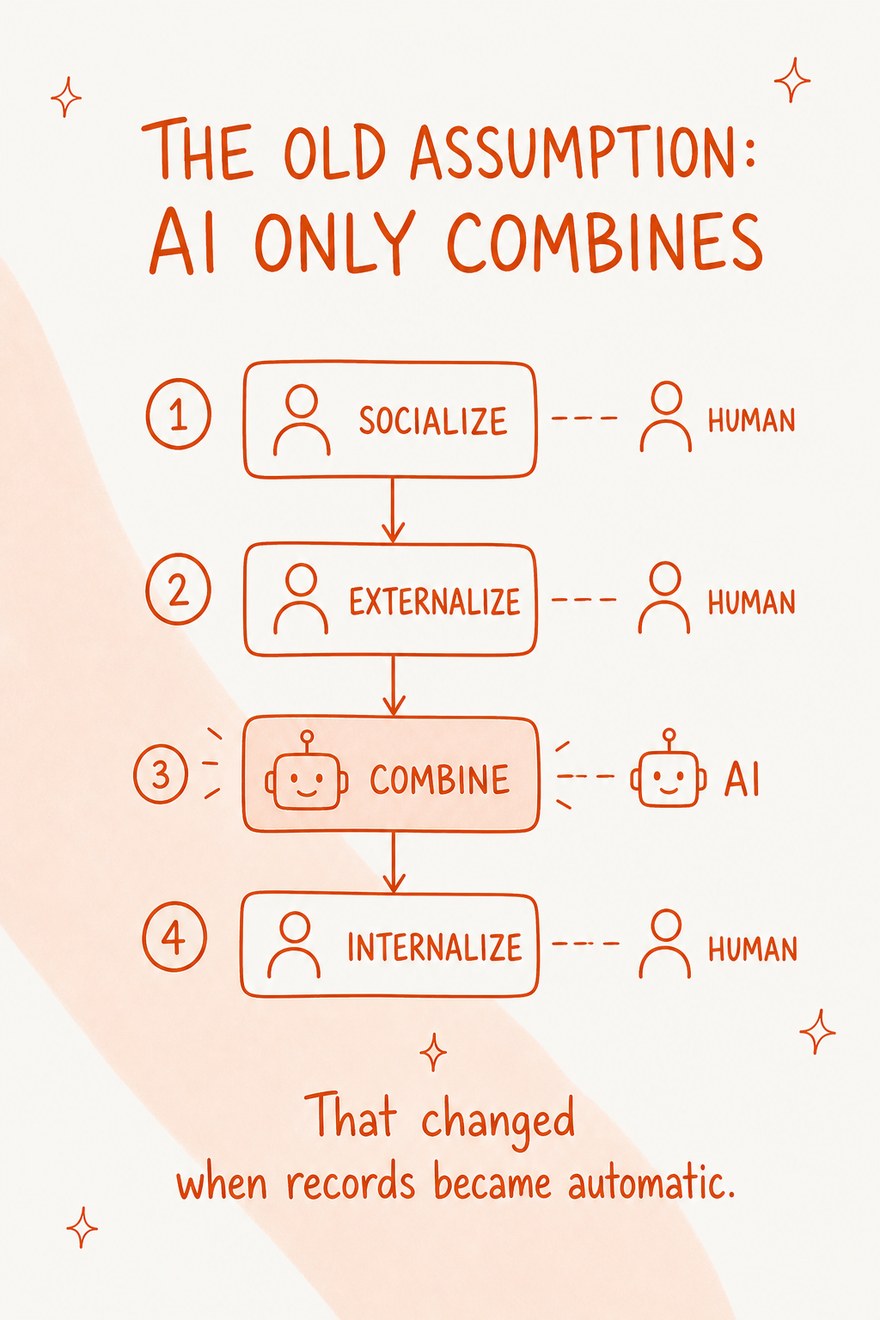
The received view: AI can only do Combination
Since generative AI arrived, the theory has been retold in a fixed shape.
What AI is good at is Combination. Read across scattered documents, summarize, systematize — that part you can delegate. But Socialization and Internalization belong to the human body and to practice, and Externalization still requires a person to articulate. So installing a tool doesn't move knowledge management forward.
That reading is correct. At least, it was correct until now.
But the conclusion rests on a single assumption: that a record is something a human makes by hand.
The bottleneck was Externalization, and it was a recording problem
Ask why knowledge never accumulates in practice and the answers converge. Too busy to write it down. No time set aside. Meant to write it up later and forgot.
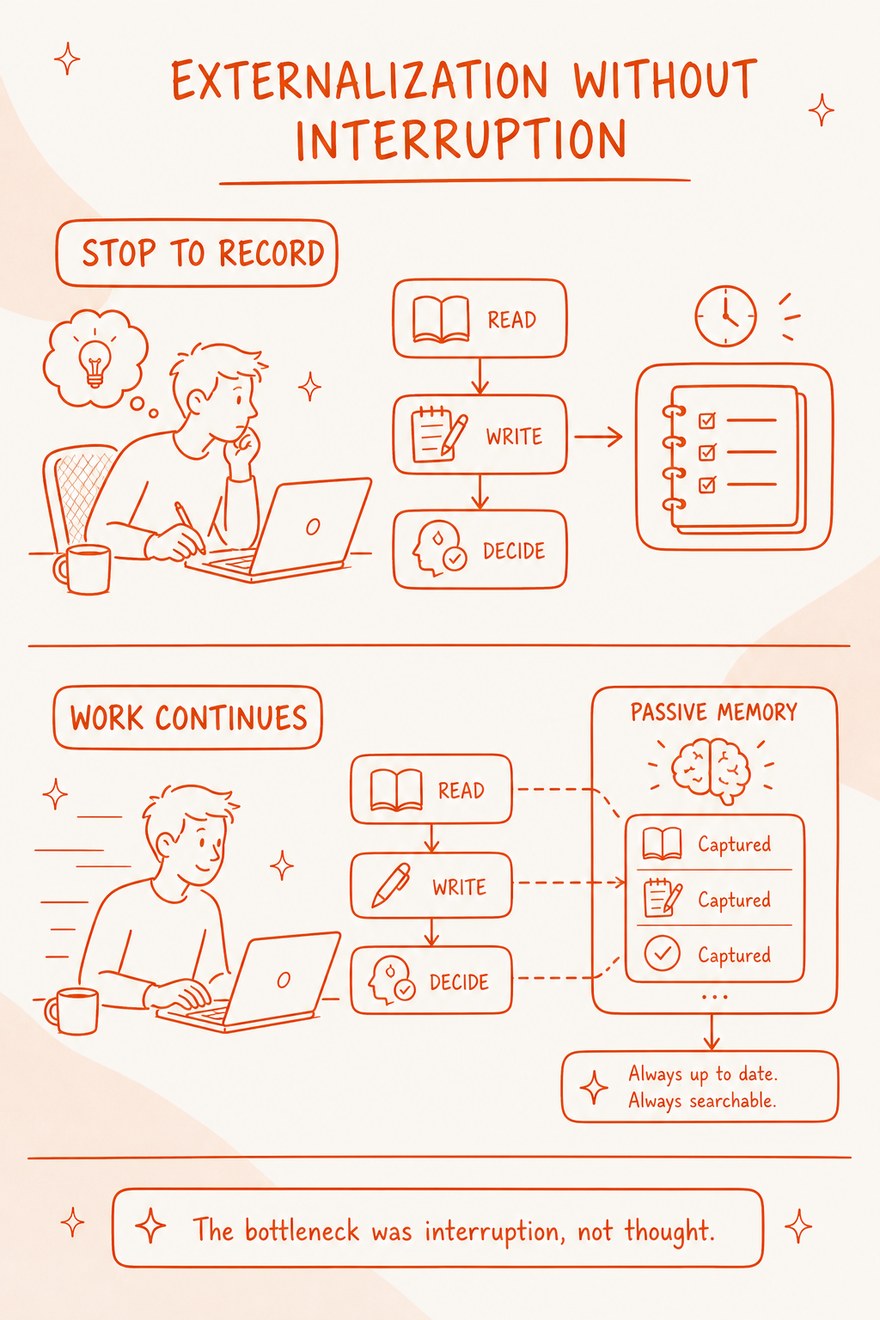
This is not a problem of articulation. Ask a veteran what they saw and why they decided, and they can explain it. What they can't do is explain it without stopping work to do so.
The cost of Externalization was never the cost of thinking. It was the cost of interruption. And once that cost approaches zero, the process stops depending on human willpower.
ShogunAI passively remembers what you read, wrote, and decided over the course of a day. You never have to intend to record it. You never have to stop working to write it down. Externalization happens as a by-product while you work.
That is where the received view loses its premise.
Putting the four processes back inside one person
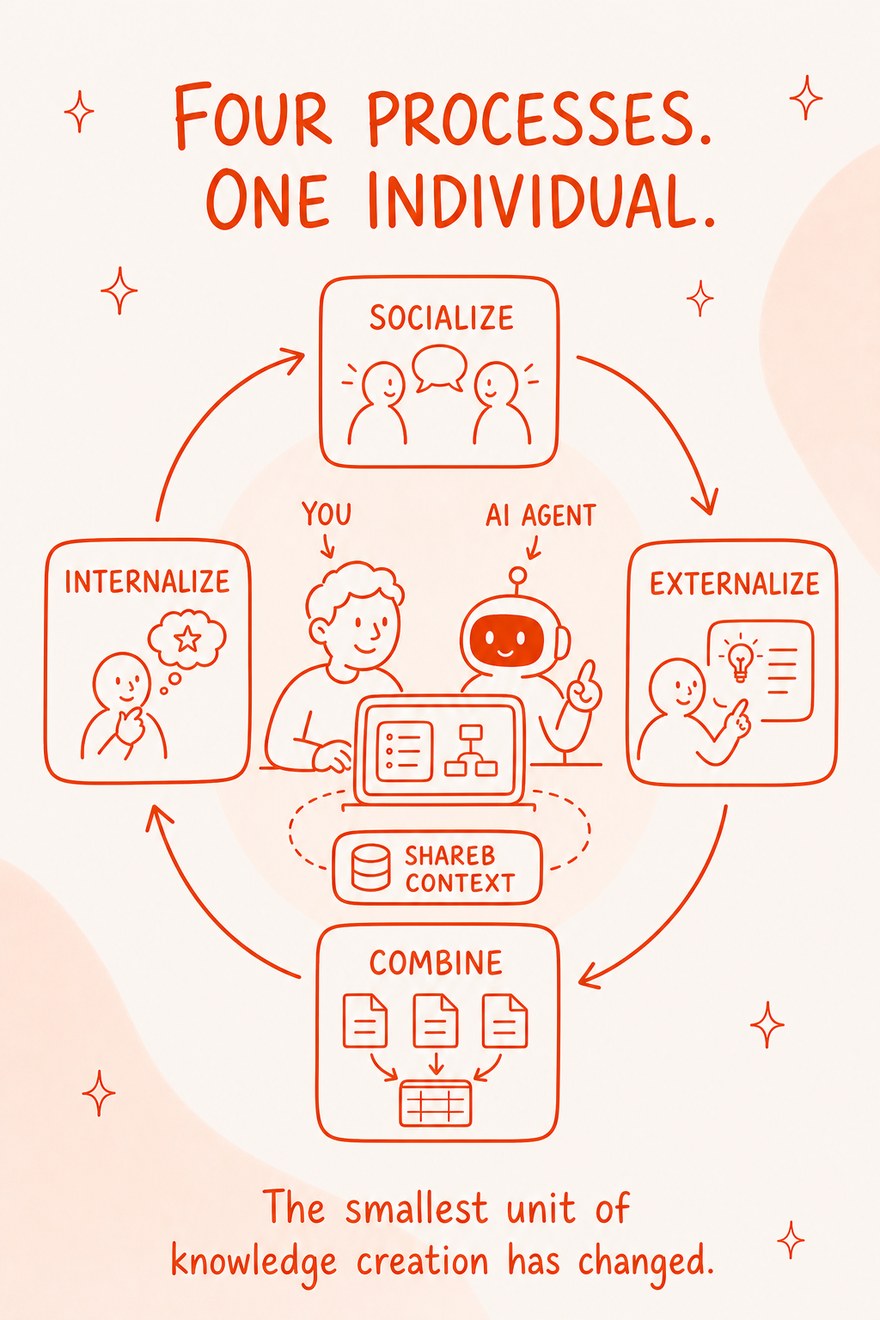
SECI was built as a theory about organizations. Socialization happened between a senior and a junior; Combination happened across departments.
But the smallest unit of knowledge creation is no longer an organization. It is one person and the agents they run. Relocate the four processes to that unit and each one changes.
Socialization. An apprentice standing beside the master, learning from their hands. That structure survives intact. Your agent watches the same screen for the same hours. It doesn't start from what it was told to do — it starts from knowing how you actually work.
Externalization. As above, passive memory carries it. You don't write. The record exists anyway.
Combination. The memory accumulated during the day is organized overnight — the step we call the Dream Cycle. Fragments are matched, linked, and returned as the next morning's brief. This is the part AI was always strongest at.
Internalization. This is the interesting one. Turning explicit knowledge into your own judgment through practice used to be something only humans did. In ShogunAI, the agent executes, and the result goes back into memory. Decisions that worked accumulate as patterns; decisions that failed accumulate as lessons. The next time the same situation appears, the agent's proposal is that much sharper.
Which means Internalization now has two subjects: you, and your agent.
When the spiral closes
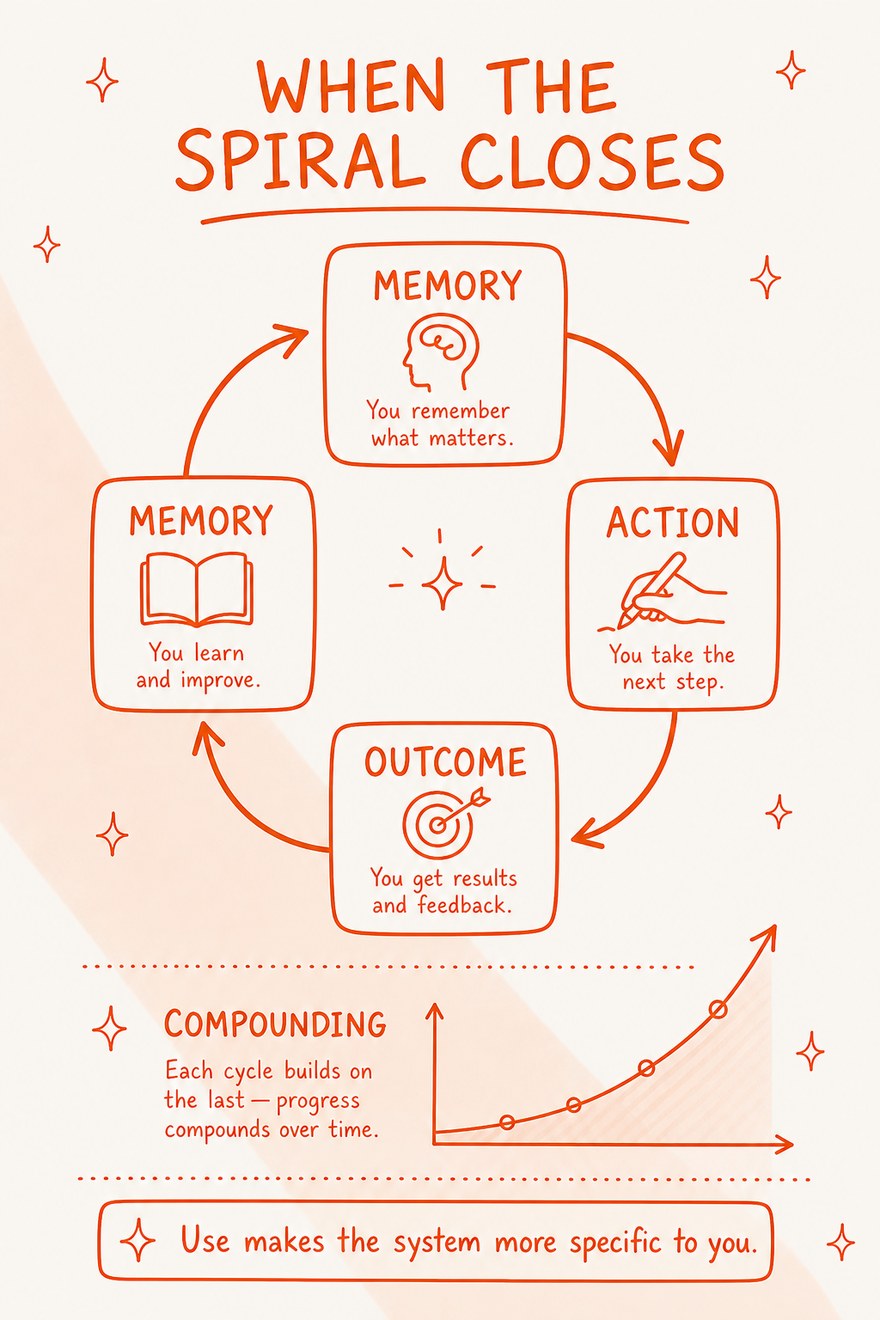
What happens when all four processes turn in the same place?
Memory produces execution, and the result of execution returns to memory. The moment that loop closes, accumulation becomes compounding. The more you use it, the more knowledge specific to how you work piles up — a set of judgment criteria that exists nowhere else.
That state is exactly what Nonaka called a spiral. He expected it to happen inside an organization. We think it happens inside a person.
For the individual without a Ba
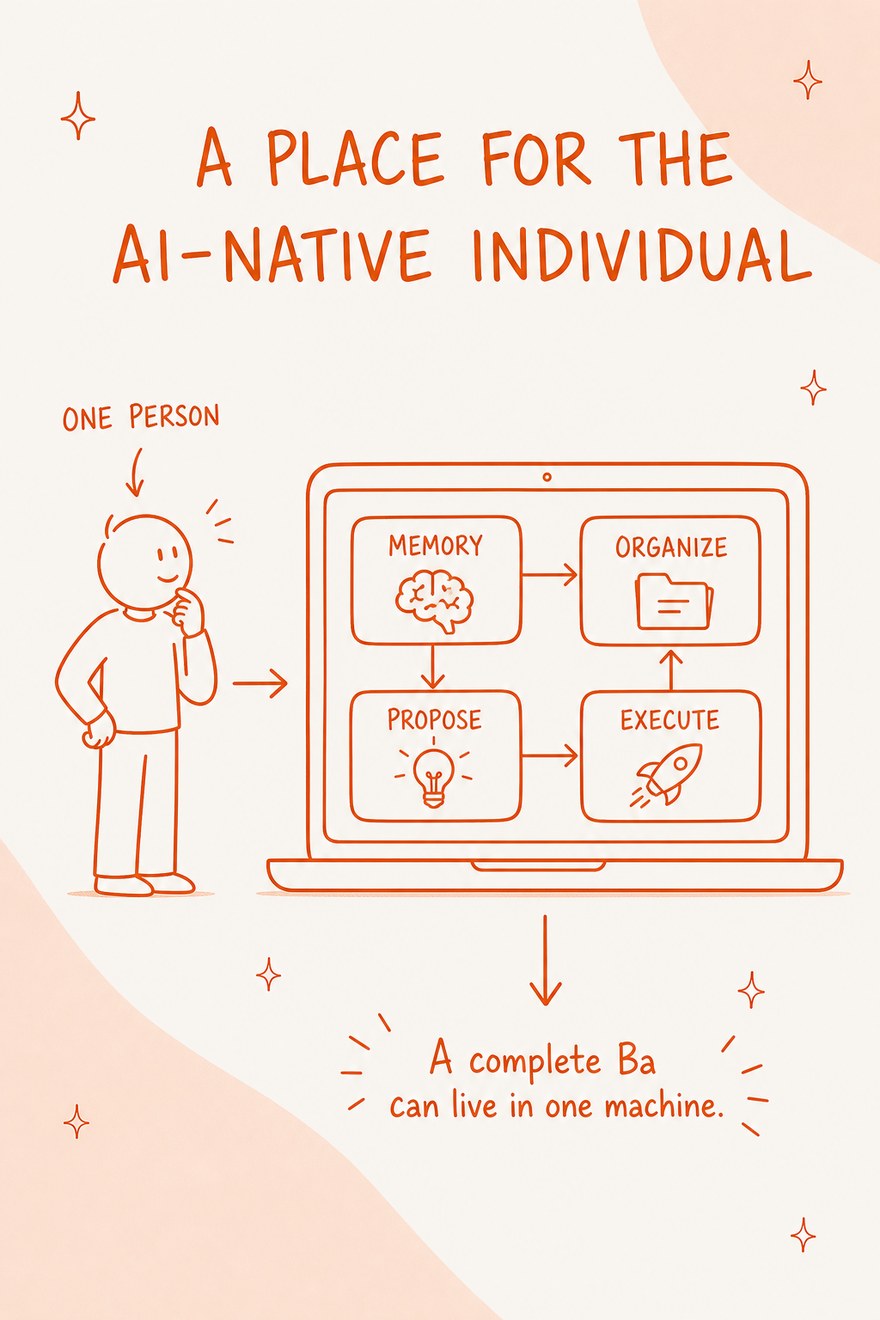
Nonaka's theory has one more important concept: Ba, the shared context or place.
Knowledge doesn't move because documents are stored somewhere. It circulates only where there is an environment for people to converse, interpret, and carry things into practice. Nonaka named a Ba for each of the four processes: originating, dialoguing, systemizing, exercising.
Of those, the systemizing Ba was the only one a tool was supposed to be able to hold. The rest existed only between people.
So where is the Ba for someone who works alone?
Founders, researchers, independent builders — none of them have an organization to serve as a Ba. No break-room chatter. No planning meeting. They still stack up decisions, create knowledge, and ship results. There was simply nowhere for that knowledge to collect.
ShogunAI puts that Ba inside one Mac. Remember, organize, propose, execute, return the result. Four places in the same place.
In 2007 the iPhone consolidated the phone, the camera, the browser, and music into one device. In 2026 ShogunAI consolidates memory, execution, and data sovereignty into one OS. The era of fragmented AI tools ends here.
From AI that remembers to AI that acts.
ShogunAI — the operating system for the AI-native individual.