The CEO of the most powerful AI company said his own problem is forgetting
The headline from Sam Altman on Relentless was the singularity. The more useful line was the one where he compared himself to a not-very-smart AI model that holds a lot of context and then loses it.
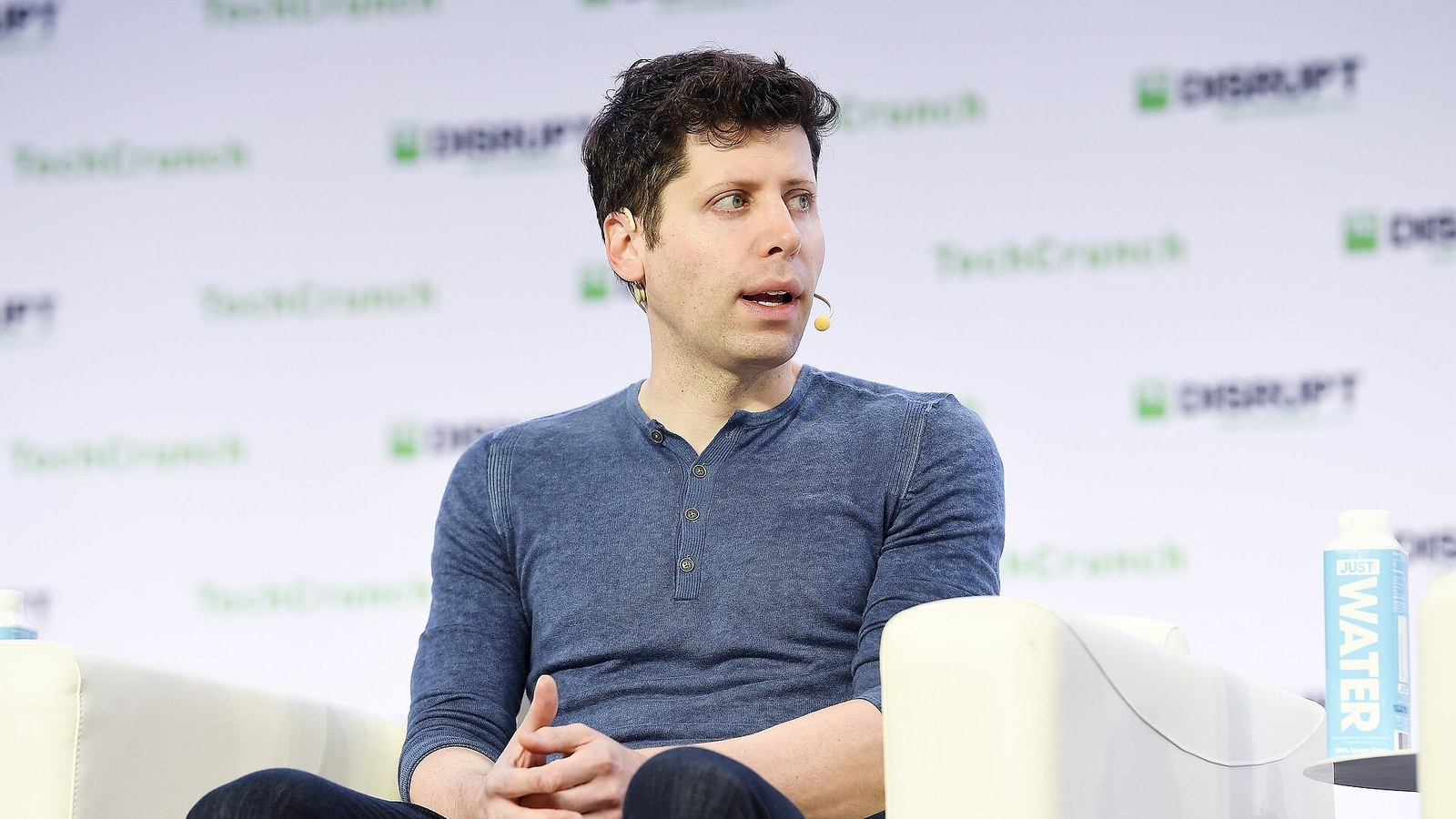
Photo: Steve Jennings / TechCrunch (TechCrunch Disrupt SF 2019) — cropped · CC BY 2.0
The headline went somewhere else
On the Relentless podcast published July 25, 2026, Sam Altman said we are already inside the singularity. By the next morning the line was everywhere, and it stayed in circulation for days.
Listen end to end, though, and the quoted part isn't the most informative part. The singularity remark restates a worldview he has repeated for years. The passage worth stopping on came from an aside — host Ti Morse coming at him from a different angle — where he reached for a metaphor to explain how he himself works.
He said he is like a not-very-smart AI model: holding an enormous amount of short-term context and then forgetting it.
That isn't modesty, and it isn't self-deprecation. It's a diagnosis, and probably the most accurate one anyone has offered so far. The problem is that he hasn't solved it.
1. The third wave is defined by staying
Start with the frame. Altman sorts AI products into three waves.
The first is the chatbot, ChatGPT being the example. The second is the coding agent, which is the one exploding right now. The third is the persistent agent — something that works autonomously over long stretches. He reached for chief of staff, colleague, partner. And he added that it arrives soon.
What's worth noticing is that the three stages are divided by form, not capability. The gap between wave one and wave two was never intelligence; it was the shape of the relationship — answer when summoned, versus take a task and run with it. Wave three isn't about capability either. It's about whether the thing disappears or stays.
A chat ends when the conversation ends. A coding agent ends when the task does. A chief of staff doesn't end. That is the whole definition.
And staying means having memory. He placed his bet on the memory side, not the capability side.
2. What decides the quality of a decision isn't intelligence
Why does staying matter that much? The answer sits right next to the metaphor.
Morse brought up an earlier remark of Altman's — that he exchanges messages with 300 to 400 people a day. Altman confirmed it and immediately called it a bad habit, not a good one. It eats time and it costs attention.
Asked why he keeps doing it anyway, the answer was enormous context.
His example is unglamorous and it's the core of the whole interview. Suppose one morning he knows a research breakthrough is close. The decisions he makes that day about a customer or a supplier come out slightly differently. If he hadn't known that morning, he would have decided differently — and worse.
There is an asymmetry buried in that. What separated the two decisions was not his thinking. It was whether he had the information that morning. Same person, same intelligence, same experience. Only the context differs, and the quality of the conclusion moves.
So he messages 300 people a day. One of the most expensive calendars on earth spends itself on a habit its owner openly calls costly, because there is no other way to get the thing. On the human side, context acquisition is still manual labor.
This is the industry's most important realization of the last two years, restated by someone in a position to know. Model intelligence is no longer where the difference is made.
3. And then he forgets
The second half of the metaphor is heavier than the first.
At acquiring context he is probably near the top of the species. Three hundred parallel conversations, fragments joined in his head. That isn't the problem. The problem is that the context he acquired isn't there the following week. That single point is what made him compare himself to a model. A large context window still empties when the session ends.
When you hand AI a piece of work today and it disappoints, the cause is rarely a shortfall in intelligence. What's missing is precedent: who you are, what you and this person have already been through, how this deal arrived at its current shape. As long as you explain from zero every time, you don't have a capable report — you have an endless rotation of people on their first day.
Humans and AI are stuck in the same place. Not on acquisition. On retention.
The third wave is defined by staying because that is the only place a solution can live. And the fact that this diagnosis comes from the CEO of the company with the most powerful AI tells you where the industry actually is. What he described is not the kind of problem a smarter model fixes.
4. The man who turned off notifications is building a personal device
Later in the same interview, Altman talks about how he uses his own devices.
He has notifications off almost everywhere, and called turning them off even in his messaging app a large improvement to his life. On TikTok he is blunter: he went in to study it for Sora's sake, got caught, and spent three hours on a couch one Saturday afternoon. He enjoyed it like a drug, he said, and could tell it wasn't good for him. He deleted the app. His stated reason was that he doesn't have the self-control to keep it.
Then he describes the device he is building with Jony Ive, and says he believes it will be wonderful and beautiful and genuinely useful. In the same breath he says people will abuse it and that it will make some lives worse in ways nobody predicts, because that is what powerful technology does.
The candor deserves credit. But a design fork is sitting there in the open. Personal AI can go in two directions: take attention and extend time on device, or protect attention and carry only the context. TikTok is the finished form of the first, and he removed it from his own phone.
A builder building something he can't use himself is, by itself, an answer about design.
5. You will not get free time
He also flatly rejects the standard story told about personal AI's benefit.
Technology has promised shorter working hours and more leisure for a long time. Directionally it delivered — people have more leisure and better lives than at any point in history. But the four-hour work week has never once arrived at the scale of a society, and he doesn't think AI changes that.
The reason is on the human side. Expectations keep rising, we always want more, we invent new things to do. It is a relative game, and people care intensely about where they stand next to others. So in a world of superintelligence we will be far busier than we imagine — and, he predicts, quietly satisfied about it while complaining out loud.
That rewrites the value proposition for personal AI. If people never get idle, freeing up time isn't something you can sell. Freed time refills instantly.
What's left is elsewhere. If the volume of work doesn't fall, the thing that can fall is the cost of carrying the same context around again and again. Explain it, recall it, search for it, explain it again. Whether a human can absorb the increased workload depends entirely on whether that carrying cost comes down.
6. Whose hands it ends up in
One more passage, the one where he used his strongest language.
Asked which AI risk worries him most, he didn't name runaway capability. He named AI authoritarianism — a very small number of people or companies deciding to control the world through AI. He called it a very bad outcome, and noted that in human history, trading freedom for safety has always been a net loss over the long run. Hence: make AI extremely abundant, extremely cheap, and put it in everyone's hands.
The position is consistent. But connected to everything above, one question goes unanswered.
What gets handed out abundantly is intelligence. What accumulates is memory.
A third-wave agent is only useful if someone's working context, decision history, and per-person precedent have piled up somewhere. That pile is also a copy of a life. You can put intelligence in everyone's hands and still, by collecting the memory in one place, return the concentration of power to exactly where it started.
In this interview he says nothing about where that memory should sit.
7. The diagnosis is finished. The answer isn't
Three things are settled by this interview.
First, the next stage of AI is defined by persistence, not capability. Second, what separates a good decision from a worse one is not intelligence but the context in hand at that moment. Third, the human bottleneck is not acquiring context but retaining it.
The CEO of the company with the most powerful AI described his own problem as an inability to retain. That means the consensus has formed. A few years ago AI products were judged on model performance. Not any more.
What isn't settled matters more. Where does that memory live, who holds it, how does it accumulate? This interview has no answer. He has described elsewhere a direction for ChatGPT's memory — pour an entire life into one enormous context — but nobody has yet explained how that squares with his own principle of putting it in everyone's hands.
This isn't a criticism. It's an observation that the spot is open.
A field where the diagnosis has gone mainstream and the prescription hasn't arrived does not stay open for long.
Coda — authority is borrowed, memory is built
Model intelligence will be fully commoditized within a few years. Every product will pull the same grade of intelligence from the same APIs. What's left between products at that point is not intelligence. It's whose context that intelligence runs on.
Intelligence is borrowed. Tomorrow it gets swapped for something stronger. What accumulates is memory: it survives the swap and it thickens with time. And — this is the part that matters — as long as it stays on your machine, it stays yours.
What we are building is the place it sits.
ShogunAI — Your AI has memory. Now it acts.
Source: Relentless (host: Ti Morse), Sam Altman episode, published July 25, 2026.